
Traffic Management Plans (TMP & TGS)
TMPs and TGS drawings that pass council and TfNSW first time.
Overview
Traffic Management Plan, Traffic Control Plan and Traffic Guidance Scheme preparation for NSW projects. AS 1742.3 and TCAWS-compliant, council-ready, and designed around your real site conditions.
A Traffic Management Plan is only as good as the drawing that sits under it. Too many projects lose days to TGS revisions after submission — misaligned tapers, missing longitudinal zones, undersized buffer distances, pedestrian paths that don't meet AS 1428, tapers calculated for the wrong speed, or plans that simply don't reflect the site. Our designers draw plans that pass council and TfNSW review first time, because they hold Prepare Work Zone TMP (Orange Card) accreditation and they've spent enough time on the ground to know what a reviewer actually looks for.
Under the NSW framework, works on public roads are governed by AS 1742.3:2019 Traffic Control for Works on Roads, the Austroads Guide to Temporary Traffic Management (AGTTM) and — for TfNSW jurisdiction — the TfNSW Traffic Control at Work Sites (TCAWS) manual (Issue 6.x current). The hierarchy is: the Traffic Management Plan (TMP) is the strategic document covering the project, its approach, responsibilities and risk controls; the Traffic Guidance Scheme (TGS) is the scaled drawing inside the TMP showing the actual field layout, including any per-stage variants. (TCP / Traffic Control Plan is the legacy term for what's now the TGS — the renaming landed with AGTTM in 2019/2020.) For TfNSW-classified roads, the Road Occupancy Licence (ROL) is the approval instrument, and for council roads it's typically a council road-opening or Section 138 permit.
Our TMP preparation follows the TfNSW template structure: project overview, governance, stakeholder engagement, risk assessment, traffic impact assessment, staged TGSs, incident and emergency response procedures, quality and audit arrangements, and monitoring. For projects that need a full TMP — typically anything on a classified road with material duration or complexity — we deliver a bound document with revision control, referenced drawings, SWMS cross-references and the supporting attachments council or TfNSW expects.
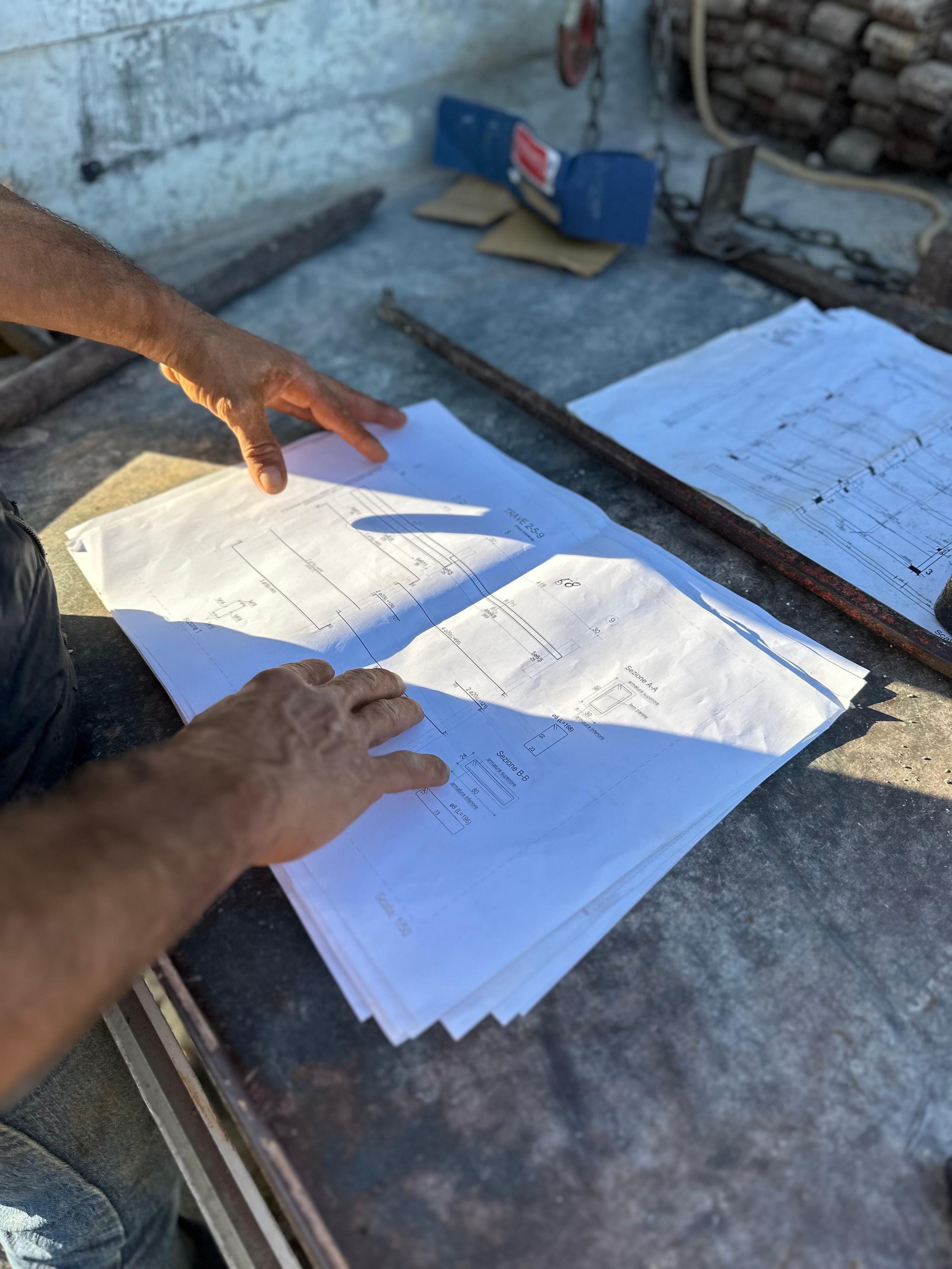
TGS drawings are our biggest throughput. We draw plans to scale, use the TCAWS symbol library, specify correct sign types (W5-7, W8-14, T1, T2, T3 series etc.), calculate tapers at the correct ratio for the posted speed, show longitudinal and buffer zones to spec, detail pedestrian management with AS 1428-compliant detours, and include site-specific notes on sight distance, intersection impact and emergency access. Every drawing is signed by an Orange Card holder.
For complex or staged projects we draw multiple TGSs — one per stage — and sequence them in a staging matrix so the site team knows which plan is active on which day. For short-duration works we can turn around a single TGS in 24 to 48 hours with the right site information. For larger TMPs with multiple stages and road classes, typical turnaround is 5 to 10 business days.
We also audit third-party TGSs (and any legacy TCP drawings still in circulation). If you've got a plan from another provider and you're not confident in it — or if a reviewer has come back with comments you don't understand — we'll audit the drawing against AS 1742.3, AGTTM and TCAWS and give you a straight written assessment. Sometimes the existing plan is fine and the reviewer is wrong; sometimes it needs significant rework. Either way, we'll tell you honestly.
ROL lodgement is part of the service. For TfNSW-classified roads we lodge the ROL application, handle any Traffic Management Centre (TMC) queries, and manage revisions if TMC requests changes. Typical ROL turnaround from TfNSW is 10 to 21 business days for standard impacts; higher-impact occupancies can take 6+ weeks. We build that into the project timeline upfront.
For council road-opening and Section 138 permits we handle lodgement with all major NSW councils. Each council has a slightly different process — some entirely online, some requiring emailed drawings with a cover letter — and we keep the templates for the councils we work with regularly.
When a plan is rejected, we fix it and resubmit. When a plan is approved but the site conditions change, we reissue under revision control and update the ROL. Drawings are living documents until the job closes.
We work with designers, project managers, head contractors, subcontractors and direct clients. You don't need to engage us for the physical traffic control to use our design service — we routinely design plans for crews other than ours. Our job is to draw a plan that works. Your job is to deliver the project. Both are easier when the TMP and TGS are right from the start.
What you get with TMP & TGS
AS 1742.3:2019 and TCAWS-compliant TGS drawings
Full Traffic Management Plans to TfNSW template
Orange Card-signed TGS for high-speed and classified roads
Multi-stage TMPs with sequencing matrices
TGS audits of existing or third-party plans
Road Occupancy Licence (ROL) lodgement and management
Council Section 138 and road-opening permit handling
Revision-controlled drawings for live project changes
Who we do this for
We tune scope, crew size and gear to the client — here are the teams we most often deliver this service for.
Project managers and designers without in-house TC
Head contractors needing specialist TMP design
Subcontractors preparing tender submissions
Councils and agencies outsourcing TMP preparation
Developers on multi-stage builds
Anyone needing a second opinion on an existing plan
When TMP & TGS is what you actually need
Plain-English triggers — if any of these match your job, this is the service line we'd put you on.
- Any work on a public road, footpath or shared zone where AS 1742.3 controls apply.
- TfNSW classified-road work needing a Road Occupancy Licence and approved TMP/TGS.
- Council Section 138 road-opening or Section 68 public-land approvals.
- Multi-stage civil projects where the plan needs to evolve through stages with revision control.
- Projects where another provider's TGS has been rejected and you need a clean redraft.
- Tender submissions that need a credible TMP to support pricing and risk allocation.
- Emergency-works framework TMPs for utility operators (template plans for after-hours response).
- TGS audits when you've been handed a third-party plan and aren't sure it's compliant.
Typical projects
A snapshot of the kind of work this service line delivers across NSW every week.
- Multi-stage TMP for civil infrastructure works
- TGS drawing packs for residential subdivisions
- ROL-ready documentation for TfNSW corridor work
- Council Section 138 road-opening packages
- TGS audits of third-party plans
- Emergency-works TMP templates for utility operators
How TMP & TGS jobs come unstuck
Honest list — these are the failure modes we see when traffic control is skipped, under-scoped or handed to a generalist.
TGS drawn at the wrong scale or without the TCAWS symbol library.
What happens: Reviewer flags the drawing on first pass. Resubmission cycle adds 2–4 weeks. Programme slips before site is even open.
Tapers calculated for the wrong posted speed.
What happens: Approved plan, but a real safety failure on day one. SafeWork notification, control failure attribution, and the next reviewer at TfNSW remembers your designer's name.
Pedestrian detour inadequate for AS 1428 — no kerb ramps, narrow path, no tactile indicators.
What happens: DDA complaint, council escalation, and the plan gets pulled mid-project to retrofit. Compounding cost.
Single static plan covering a build that has six distinct stages.
What happens: By stage 3 the plan is fiction. The site team works to memory, the audit trail breaks, and the next incident has no defensible plan reference.
ROL lodged at the same time as council Section 138 — no recognition of the different timelines.
What happens: Site mobilises off the council approval and waits 3 weeks for the ROL. Planned start date misses, head contractor charges back. Foreseeable.
From first call to TMP & TGS on site
The shape of an engagement on this service line. Same process whether it's a single shift or a multi-year contract — only the scale changes.
Brief and site information
Brief call to understand the project — scope, road class, posted speed, programme, stakeholders, expected duration. We pull the site survey, council mapping and TfNSW corridor data we need to draw realistically.
Strategy and stage breakdown
For multi-stage projects we map out the stages with you, identify the trigger between stages, and work out which plans need to exist when. The TMP table of contents reflects the actual build, not a generic template.
TGS drafting (Orange Card-signed)
Designers draw the TGS to scale, using the TCAWS symbol library, with correct sign types, taper rates calculated for posted speed, longitudinal and buffer zones to spec, and pedestrian management compliant with AS 1428. Every TGS is signed by an Orange Card holder.
TMP document compilation
Where the project needs a full TMP, we compile to TfNSW template — project overview, governance, risk, traffic impact, staged TGSs, incident response, audit and monitoring. Bound, revision-controlled, ready for council or TfNSW.
Lodgement and reviewer management
ROL to TfNSW, Section 138 to council — submitted with cover letter, supporting docs and SWMS. We manage reviewer comments without bouncing them back to you for translation.
Live revisions and project close-out
When site conditions change, we reissue the TGS under revision control and update the ROL. At project close we hand back a clean documentation pack — every revision, every approval, every incident referenced.
What you're actually paying for
No hidden margin — these are the levers that move the price up or down on every quote we write for this service.
TGS complexity
Single-stage local-road TGS is a flat fee. Multi-stage TGS, classified-road environments, or intersections with signal interaction take design hours that scale with complexity. We quote the design hours, not a flat 'TMP package'.
Full TMP document vs. TGS only
Many smaller projects only need a TGS. A full TMP (governance, risk, staging matrix, audit framework) is a separate scope, typically required on TfNSW corridor or major-project work.
Lodgement and reviewer management
ROL lodgement and management is quoted as a single fee that covers the submission, queries, revisions and final approval — not per email exchanged with TfNSW.
Audit of third-party plans
TGS audit is a fixed scope quoted by drawing — review against AS 1742.3, AGTTM and TCAWS, written assessment delivered within 5 business days. Rework if needed is quoted separately.
Revision cycles
Plans we drew get revised at no extra cost during reviewer feedback rounds. Mid-project reissues triggered by changed scope or site conditions are quoted per revision.
Geography
We draw plans across NSW. Council-specific lodgement processes (we know about 35 councils' templates by heart) are included in the lodgement fee, not loaded as a separate charge.
Real shift, anonymised
One job we delivered on this service line. Names and locations are kept generic; the operating detail is exactly as it ran.
Civil drainage upgrade — multi-stage TMP, North Sydney corridor
Civil contractor delivering a $14M drainage upgrade along a North Sydney classified-road corridor — six stages, four intersections, two signalised, 14-month programme. Their original consultant's TMP had been rejected twice by TfNSW for taper inconsistency, missing buffer zones and a pedestrian detour that didn't meet AS 1428 at the bus-stop interface. We took over, redrew all six stages over 9 working days, restructured the TMP to TfNSW template with a clear staging matrix, and submitted a complete pack with supporting SWMS and ITPs. ROL approved on first review, 13 business days. Six stage revisions through the programme — each one approved on first review by the same TMC reviewer, who at the end emailed the contractor: 'these were the cleanest stage submissions I've had this year.' The kind of result that puts a designer on a contractor's preferred-supplier list and earns repeat work on the next corridor.
Regulations & accreditation
Every TMP & TGS job is delivered to the current NSW standards and codes of practice.
Regulations we work to
- AS 1742.3:2019 Traffic Control for Works on Roads
- TfNSW TCAWS manual
- Orange Card Prepare Work Zone TMP
- NSW Roads Act 1993 Section 138
- TfNSW Road Occupancy Licence framework
- AS 1428.1 pedestrian access and mobility
TMP & TGS — FAQs
Frequently asked questions
TMP & TGS across NSW
Our most-requested NSW locations for this service. Click through for local detail — landmarks, major roads, project history and response times.
Other services we run alongside TMP & TGS
Most NSW projects need more than one of our service lines at some point. Here are the ones we hand off to most often on this kind of job.
Construction Traffic Control
Traffic control that keeps your build on program.
See ConstructionRoad Maintenance & Line Marking
Road maintenance traffic control that moves with the crew.
See MaintenanceCouncil & Government Contracts
Contract-ready traffic control for NSW councils and agencies.
See GovernmentSpecial Events Traffic Management
Event traffic plans that actually survive the day.
See EventsNeed TMP & TGS on your NSW site?
Send your dates, site address and scope — we'll come back with a crew, a gear list, and a fixed quote.