
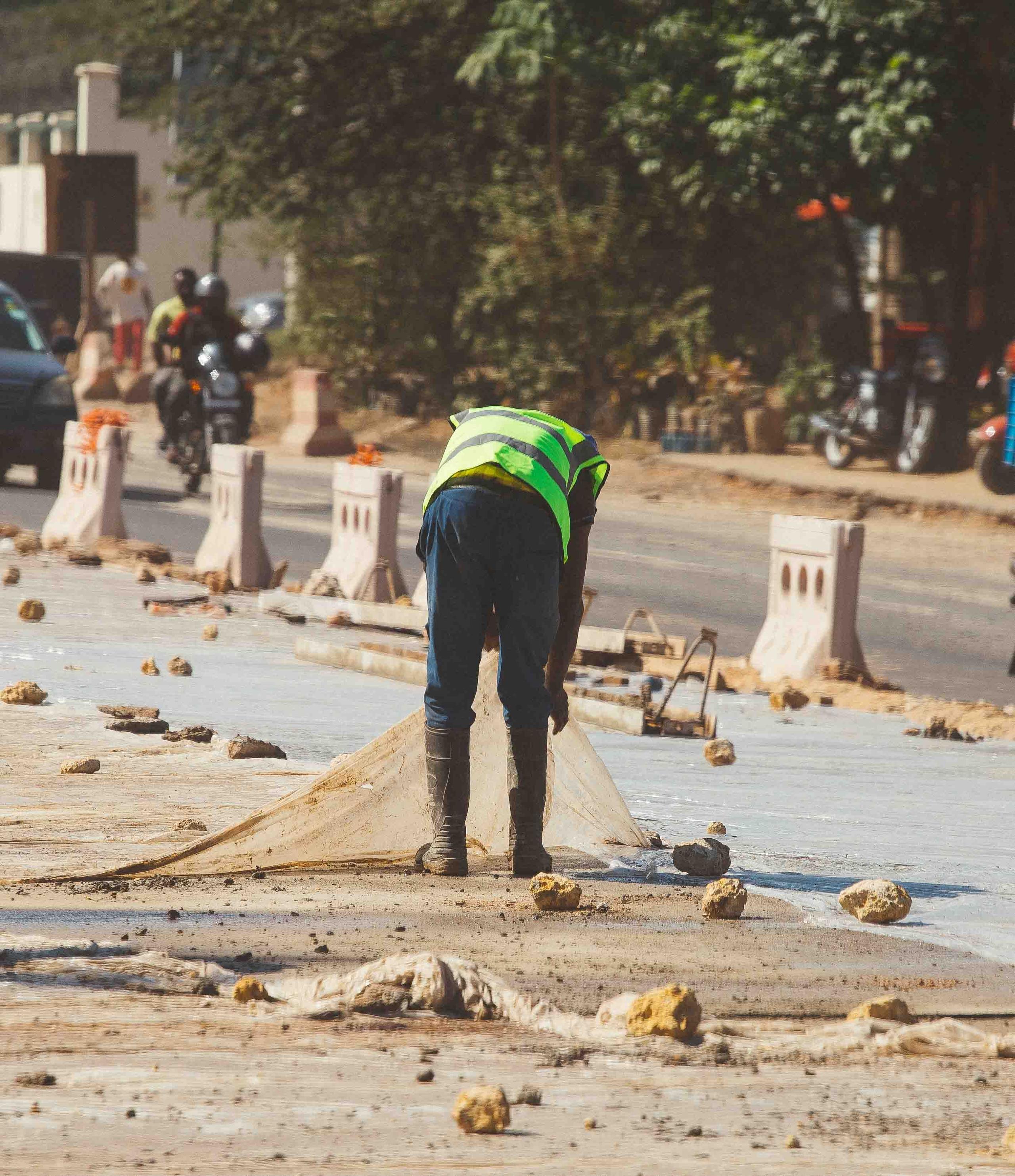
Road Maintenance & Line Marking
Road maintenance traffic control that moves with the crew.
Overview
Traffic control for pavement repair, line marking, resurfacing, crack sealing and routine road maintenance across NSW. Rolling closures, night shifts and compliant TGS for council and TfNSW asset contractors.
Routine road maintenance is where traffic control earns its keep — rolling closures, narrow windows, fast setup and just as fast breakdown, all while live traffic rolls past at posted speed. Our maintenance crews are built for exactly this: compliant under AS 1742.3:2019 and the TfNSW TCAWS manual, but fast enough to keep up with line marking, patching, crack sealing, spray seal, kerb repair, signage replacement and pothole work without bottlenecking your asphalt truck.
For council asset contractors we regularly run rolling closures across multi-suburb programs — a typical night might cover six or eight streets in a single LGA, with a single TGS template and a crew that can set and break three or four sites before dawn. We work to your specification, deliver daily dockets with start/finish times, setup photos and square-metre coverage if you need it, and we close out the job with proper as-constructed records.
Line marking is a specialty in its own right. Thermoplastic and waterborne paint both have tight cure times, and the traffic control needs to protect the curing line while the crew moves on. That means compliant tapers for the line-marking truck, controllers spaced per TCAWS to handle both the work area and the curing zone, and a clean breakdown sequence once the paint's trafficable. We've worked alongside most of the NSW line-marking contractors and we understand their tempo.
Resurfacing — whether profiling, asphalt overlay, microsurfacing or spray seal — is the biggest maintenance category. The TGS has to handle the profiler, the sweeper, the bitumen tanker, the paver and the rollers, all in sequence, usually at night. Our crews are across the detour logic, pedestrian management, heavy-vehicle access and the clean-up stage. For spray seal in rural NSW we also handle stone sweep-up traffic and the return-run protection required before the seal fully cures.
Crack sealing, pothole repair, failed-patch reinstatement and shoulder grading are the bread-and-butter jobs that most councils now outsource. For these we keep our rates tight and our crews small — typically a two-person stop/slow setup for a single lane plus a buffer, sometimes with a shadow vehicle if the posted speed is over 80 km/h. We don't over-man a job and we don't under-man one either.
TfNSW's Road Maintenance Council Contract (RMCC) and similar regional maintenance contracts have specific TGS and reporting requirements — we're familiar with them and we provide the documentation your contract manager needs. That includes pre-start photos, mid-shift traffic checks, incident logs and any near-miss reporting required under your Safety In Design framework.
We also handle bridge maintenance, guardrail repair, signage renewal and crash-attenuator replacement. These are different again — often short closures during off-peak daytime hours on classified roads, sometimes requiring full carriageway closures with local detours signposted for multiple days. We coordinate with TfNSW Traffic Operations (TMC), build compliant VMS messaging, and make sure our detour signage reads correctly from vehicle speed, not desk speed.
For sealing and stabilisation works in regional NSW we can crew multi-week campaigns with standing rosters, accommodation coordination if required, and fatigue management that meets Heavy Vehicle National Law. Remote stretches of the Pacific, Princes, Hume, New England, Oxley and Sturt highways are all familiar work for our Hunter, South Coast and regional crews.
Finally, we can bundle our own line marking and asphalt partners where you want a single invoice. For smaller councils and developers this often saves a full round of subcontractor management — one purchase order, one site contact, one daily diary.
If you're a road maintenance contractor looking for a TC crew that keeps up, supplies the right gear and writes clean dockets, we'd like to talk. We don't mind early starts, we don't mind night shifts, and we don't mind regional travel — that's the nature of the job.
What you get with Maintenance
Rolling closures across multi-suburb maintenance programs
Line marking protection with cure-zone management
Resurfacing and asphalt crew coordination
Shadow vehicle and truck-mounted attenuator (TMA) deployment
VMS boards for TfNSW corridor work
Compliant detour signage sized for posted speed
RMCC-style documentation and daily dockets
Heavy-vehicle fatigue-compliant regional rosters
Who we do this for
We tune scope, crew size and gear to the client — here are the teams we most often deliver this service for.
Council road maintenance contractors
TfNSW RMCC contract holders
Line marking specialist contractors
Asphalt and spray seal contractors
Civil maintenance and preservation programs
Bridge and guardrail maintenance crews
When maintenance is what you actually need
Plain-English triggers — if any of these match your job, this is the service line we'd put you on.
- Council asset programmes — pothole rounds, crack sealing, signage renewals across a whole LGA.
- Asphalt overlay or profiling on arterial roads, usually 9pm–5am to avoid peak.
- Thermoplastic line-marking campaigns where the controller has to protect curing lines.
- Spray seal and stone sweep-up on regional NSW highways.
- Bridge maintenance, guardrail and crash-attenuator replacement on classified roads.
- RMCC contract work where the contract spec mandates daily TC reporting.
- Multi-week sealing campaigns in the Hunter, Illawarra or New England with rolling crews.
Typical projects
A snapshot of the kind of work this service line delivers across NSW every week.
- Council LGA-wide pothole patching programs
- Night asphalt overlay on arterial roads
- Thermoplastic line re-marking campaigns
- Spray seal in regional NSW
- Crash barrier and guardrail replacement
- Signage and pavement marker renewals
How maintenance jobs come unstuck
Honest list — these are the failure modes we see when traffic control is skipped, under-scoped or handed to a generalist.
Crew sized for the work area but not the curing/cooling zone.
What happens: Vehicles drift onto fresh thermoplastic or hot mix; the line marker or asphalt crew has to redo the section and the council gets the rework bill.
No shadow vehicle or TMA on 80 km/h+ pavement work.
What happens: First rear-end into the work zone is a SafeWork-notifiable incident. The contract manager pulls you off the panel.
Detour signage typeface and size set for 50 km/h, deployed on a 100 km/h corridor.
What happens: Drivers can't read the diversion at speed, traffic backs up, and TfNSW TMC gets the complaints. VMS messaging that doesn't match the static signage compounds it.
Rolling closure programme with no template TGS.
What happens: Designer redraws every street. Cost balloons, lead times stretch, and the asphalt crew is held up waiting for paperwork.
Heavy Vehicle National Law fatigue limits ignored on multi-week regional campaigns.
What happens: A controller falls asleep in a traffic vehicle at 4am. The whole campaign stops, the prosecution lands on the PCBU, and your insurer asks awkward questions.
From first call to Maintenance on site
The shape of an engagement on this service line. Same process whether it's a single shift or a multi-year contract — only the scale changes.
Programme review
We sit with your works supervisor and look at the maintenance programme — street list, expected dates, crew sizes, equipment cycles. For LGA-wide pothole rounds we map the geography and sequence shifts to minimise mobilisation.
Template TGS
We draw a small library of template TGSs (single-lane closure, two-way stop/slow, full closure with detour) keyed to road type. Same paperwork covers ten streets — your contract manager sees one approval, not ten.
Crew rostering
Crew sized to the night, paired with shadow vehicle or TMA where the speed environment requires it. Heavy Vehicle National Law fatigue rules baked into the roster from day one.
Setup, work, breakdown rhythm
Crews work to the asphalt or line marker's tempo. Set up, hold, break down and move to the next site — three or four sites a shift on a typical council programme. We don't bottleneck the pavement crew.
Daily docket and photos
Per-shift docket: TGS reference, start/finish, square-metre coverage if your contract calls for it, photos of setup and reinstatement, crew sign-on. Lands in your inbox same morning, ready for your contract reporting.
What you're actually paying for
No hidden margin — these are the levers that move the price up or down on every quote we write for this service.
Programme scale
Standalone night shift is one rate. A 12-week LGA-wide rolling closure programme gets a lower per-shift rate because the TGS is templated and crew is locked.
Posted speed and shadow vehicle
Below 60 km/h: stop/slow crews. 60–80 km/h: shadow vehicle on most setups. 80 km/h+: TMA mandatory. Each step adds plant cost; the contract spec usually dictates which one.
Night and weekend loadings
Most road maintenance is night work. Loadings are listed per-shift type (Mon–Thu nights, Friday nights, Saturdays, Sundays, public holidays) so the figure on your invoice matches the figure on your quote.
Regional travel and accommodation
For Hunter, Illawarra, Far North Coast and regional NSW, accommodation and per-diem costs sit on the quote separately from the labour. Multi-week campaigns get a single mobilisation fee.
VMS and detour signage
TfNSW corridor work generally requires VMS — supply, programming, deployment and collection are quoted by board-day, not by line item.
Contract reporting overhead
RMCC and panel contracts that demand monthly KPI rollups carry a small admin loading. We list it so it's visible — most operators bury it in the labour rate.
Real shift, anonymised
One job we delivered on this service line. Names and locations are kept generic; the operating detail is exactly as it ran.
LGA-wide thermoplastic re-marking — 6-week campaign
Mid-Sydney council, ageing line marks across 230 streets, mostly 50 km/h residential and a handful of 60–70 km/h sub-arterials. Line-marking contractor needed a TC partner that could keep up with two trucks running parallel routes. We drew three template TGSs (centre-line, edge-line, school-zone) and ran twin two-controller crews through the LGA in 6 weeks of nights, 21:00–04:00. 138 shifts, zero rejections, two minor incidents (motorist drove around a stop sign, no impact) logged and closed out within the SLA. The thermoplastic margin held because the cure zone was held by the controller, not abandoned to traffic. Council renewed the panel for 24 months on the back of the docket quality.
Regulations & accreditation
Every Maintenance job is delivered to the current NSW standards and codes of practice.
Regulations we work to
- AS 1742.3:2019 Traffic Control for Works on Roads
- TfNSW TCAWS manual
- Road Maintenance Council Contract (RMCC) specifications
- Heavy Vehicle National Law fatigue management
- SafeWork NSW WHS Regulation 2017
- Local Council maintenance contract SWMS requirements
Maintenance — FAQs
Frequently asked questions
Maintenance across NSW
Our most-requested NSW locations for this service. Click through for local detail — landmarks, major roads, project history and response times.
Other services we run alongside maintenance
Most NSW projects need more than one of our service lines at some point. Here are the ones we hand off to most often on this kind of job.
Traffic Management Plans (TMP & TGS)
TMPs and TGS drawings that pass council and TfNSW first time.
See TMP & TGSConstruction Traffic Control
Traffic control that keeps your build on program.
See ConstructionCouncil & Government Contracts
Contract-ready traffic control for NSW councils and agencies.
See GovernmentEmergency Response & After-Hours
24/7 dispatch when the road goes sideways.
See EmergencyNeed maintenance on your NSW site?
Send your dates, site address and scope — we'll come back with a crew, a gear list, and a fixed quote.