
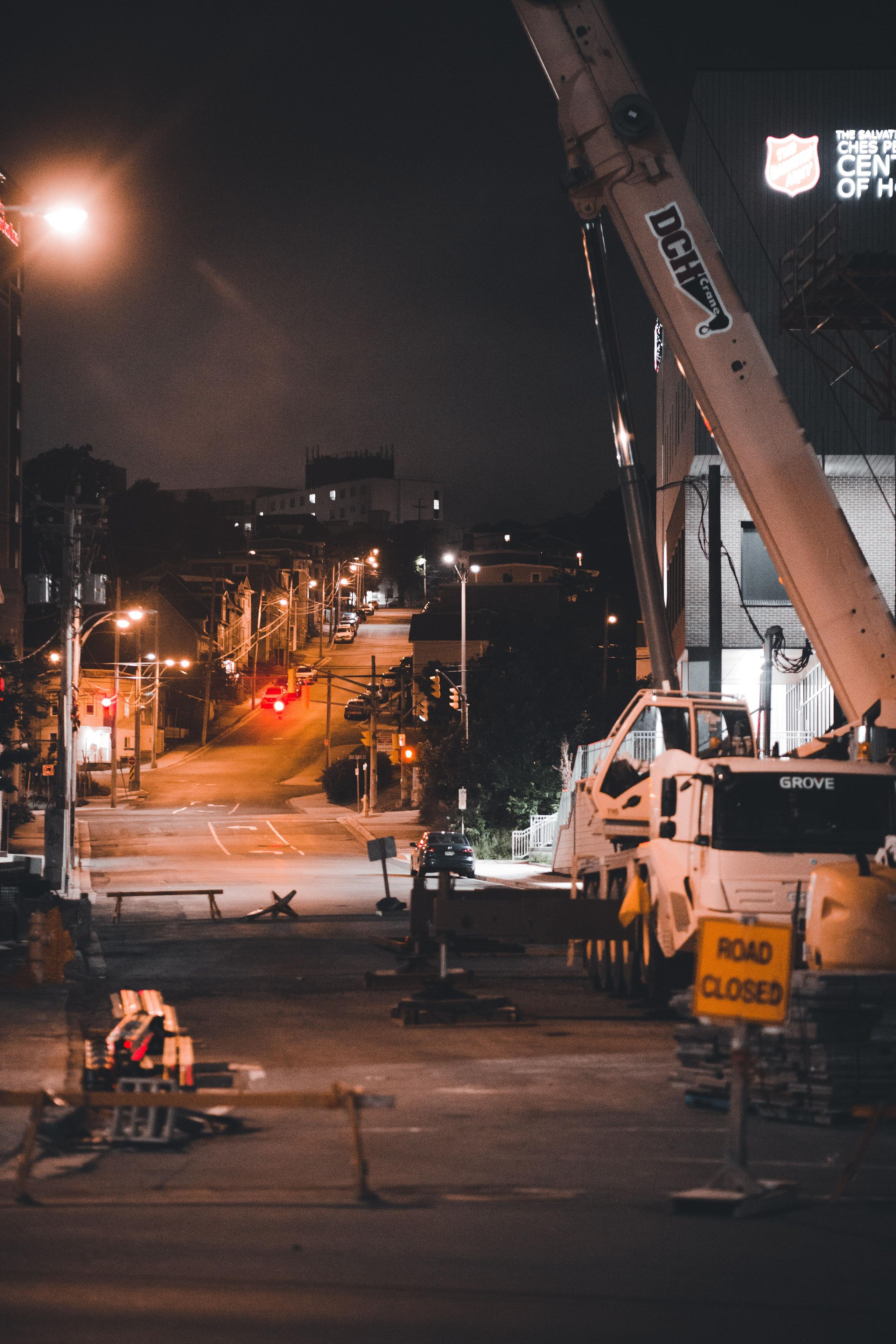
Emergency Response & After-Hours
24/7 dispatch when the road goes sideways.
Overview
24/7 emergency traffic control for incidents, breakdowns, storm damage, main bursts, power outages and after-hours utility faults. Rapid mobilisation across Sydney, Hunter, Illawarra and regional NSW.
When something fails on the road at 2am — a burst main, a fallen tree, a power-line down, a tanker rollover, a storm cell that drops half a footpath — you need a traffic control crew that's already rolling before you finish the call. Our 24/7 dispatch runs every hour of the year. Controllers, vehicles, cones, VMS and barriers are on standby across Greater Sydney, the Hunter, the Illawarra and key regional bases, with a typical on-site time of 60 to 90 minutes for the metro and inner regional areas.
Emergency response TC is a different craft to planned work. The site isn't pre-surveyed, the hazards aren't always obvious in the dark, and the other emergency agencies — Fire and Rescue NSW, NSW Ambulance, NSW Police, Ausgrid, Sydney Water, Jemena, Endeavour Energy — are running their own response at the same time. Our emergency crews are drilled on rapid, compliant TGS setup, safe arrival under lights-and-sirens conditions, and immediate integration with whichever lead agency has scene control.
For utility network operators — Ausgrid, Endeavour Energy, Essential Energy, Sydney Water, Jemena, Telstra, NBN Co — we run standing after-hours arrangements. That means named controllers at your depot list, known site contacts, pre-agreed rate cards, and a direct number that's answered by a human in seconds, not by voicemail. We supply vehicles equipped with the standard emergency kit: cones, signage, flashing beacons, water-filled barriers for short setups, VMS where accessible, and a full PPE and wet-weather spare kit for the crew.
Storm response is where we come into our own. When a southerly buster or east coast low hits, trees go down across the Pacific Highway, culverts flood under the Princes Highway, roofs lift across Newcastle and Wollongong, and the utility network lights up with 800-plus jobs overnight. Our dispatch scales with the event, we coordinate with SES and local council works depots, and we rotate crews on fatigue management so we're still operational at 5am when the third wave hits.
Main bursts and gas hits are time-critical in a different way. The pressure of the job means the repair crew has to move immediately, and the traffic control has to keep up. For Sydney Water main bursts we're familiar with their JobSIS process, their site SWMS expectations, and their contract standards for after-hours deployment. For gas — Jemena and other distributors — we meet their exclusion-zone requirements and maintain the safety zones while the repair crew commissions gas-free conditions.
Incident response on classified roads (Pacific, Princes, Hume, M1, M4, M5, M7, M2, Cross City, Eastern Distributor, Lane Cove Tunnel) means working with TfNSW Transport Management Centre (TMC) and often NSW Police scene command. Our controllers know the TMC's protocols, we take our staging instructions from scene command, and we maintain traffic flow with compliant detour signage while the response proceeds. Tunnel incidents, heavy vehicle incidents on motorways, and pavement failures all fall into this category.
For local councils, after-hours callouts usually come from the works depot duty officer — fallen trees, damaged barriers, failed signalised intersections, pavement collapses, stray stock on roads. We run ad-hoc and standing arrangements for councils across NSW.
Make no mistake: emergency response pricing reflects the 24/7 standby and rapid-mobilisation premium. We're transparent about it. A 2am callout on a long weekend has a cost. But the alternative — an unprotected work zone, an uncontrolled incident scene, public vehicles entering a live hazard — carries a cost that no PCBU wants to pay.
We take emergency response seriously because our crews do too. They're on call, they pick up, and they turn up. That's the commitment.
What you get with Emergency
24/7 dispatch with sub-60-minute metro response target
Standing after-hours arrangements for utility networks
Emergency incident response on classified roads and motorways
Storm and flood-event scaling with multi-crew deployment
Coordinated response with NSW Police, FRNSW, NSW Ambulance, SES
Main burst, gas hit and power-line-down scene control
Pre-agreed rate cards for utility operators
Rapid-deploy kit: cones, VMS, barriers, PPE in every vehicle
Who we do this for
We tune scope, crew size and gear to the client — here are the teams we most often deliver this service for.
Utility network operators (power, water, gas, telco)
Council works and depot duty officers
Principal contractors on weekend and night works
TfNSW corridor partners on incident response
Emergency services needing additional traffic control
Event operators with incident contingency needs
When emergency is what you actually need
Plain-English triggers — if any of these match your job, this is the service line we'd put you on.
- Burst water main, sewer overflow or pump-station fault on a Sydney Water network at any hour.
- Power-line down, pole strike, transformer failure or substation fault on Ausgrid, Endeavour or Essential networks.
- Gas leak, pressure fault or third-party damage on Jemena or other gas networks.
- Heavy-vehicle incident, debris on carriageway or tanker rollover on the M1, M4, M5, M7 or Pacific Highway.
- Storm response — fallen trees, flash flooding, damaged barriers, blocked culverts.
- Failed signalised intersection or traffic-signal outage on a council or TfNSW road.
- Tunnel incidents on Lane Cove, Cross City, Eastern Distributor, M5 East or NorthConnex.
- Pavement collapse, sinkhole or unexpected void in the road corridor.
Typical projects
A snapshot of the kind of work this service line delivers across NSW every week.
- Storm response across Sydney and Hunter
- Sydney Water main burst scene control
- Ausgrid and Endeavour Energy fault response
- Incident response on M1, M4 and Pacific Highway
- After-hours tree removal and pavement failures
- Tunnel and motorway incident lane closures
How emergency jobs come unstuck
Honest list — these are the failure modes we see when traffic control is skipped, under-scoped or handed to a generalist.
Operator calls a regular planned-work TC supplier — not an emergency dispatcher — at 2am.
What happens: Voicemail. The repair crew waits exposed on a live road for two hours while someone wakes up. The PCBU is the one explaining it later.
Crew arrives without arc-rated PPE for an electrical fault site.
What happens: Network operator rejects entry to the exclusion zone. Repair crew can't start. Standby costs accrue, lights stay off, customers complain.
Staging instructions taken from a passing motorist instead of scene command.
What happens: TC perimeter overlaps the operational bubble. Police or fire incident commander shuts the TC down. The job pauses while the perimeter is rebuilt.
No fatigue management on a multi-shift storm response.
What happens: Controllers driving home at 5am after 10 hours of cone work; first crash takes the crew off the road for the next storm. Insurance treats it as a foreseeable failure.
Detour signage left in place after the scene clears.
What happens: Daylight commuters follow a phantom diversion into a quiet street. Council fields complaints, you wear the demobilisation cost a second time.
From first call to Emergency on site
The shape of an engagement on this service line. Same process whether it's a single shift or a multi-year contract — only the scale changes.
Call answered, crew confirmed
Single 24/7 number. Live dispatcher picks up — no menus, no voicemail. We confirm the crew, ETA and equipment list on the call. You get a job number and a controller's name within minutes.
Mobilisation
Vehicle rolls with cones, signage, beacons, VMS where accessible, water-filled barriers for longer setups, and arc-rated PPE for electrical sites. Sub-60-minute target across Greater Sydney; 60–90 minutes for inner regional NSW.
Arrival and scene integration
Crew reports to the lead agency on arrival — Police, Fire, Ambulance, SES or the utility's incident commander. We take staging instructions, set up a compliant TGS around the agreed perimeter, and stay out of the operational bubble.
Hold the perimeter
Through the response, our role is to maintain safe traffic flow past the incident — compliant detours, pedestrian management, and adjustment as the scene changes. We coordinate with the lead agency, not assume command.
Demobilisation and reinstatement
When the scene's released, we sweep up cones and signage, confirm the road's safe and reinstated, and notify your operator's control room. No phantom detours left in place. Demob is logged like setup.
Same-shift report
Within hours of demob you get a report — TGS used, on-scene time, lead agency contact, hours, and any incidents within our perimeter. For utility MSA clients we feed shift data straight into JobSIS or your equivalent system.
What you're actually paying for
No hidden margin — these are the levers that move the price up or down on every quote we write for this service.
After-hours and 24/7 standby
Emergency response carries an after-hours rate plus a callout fee. Standing-arrangement clients (utilities, councils, principal contractors) get a pre-agreed rate card that's lower than ad-hoc dispatch.
Mobilisation distance
We charge a single mobilisation fee from the nearest crew base — Sydney CBD, Western Sydney, Newcastle, Wollongong, Central Coast — rather than per-kilometre travel time. Regional jobs price the mobilisation transparently.
Minimum shift length
Standard emergency callout is a 4-hour minimum. If the job runs longer, you pay for the actual hours; if it wraps in 90 minutes, you still pay 4. We're upfront because that's the only way the standby roster pays for itself.
Crew size and incident type
Single-controller residential main burst is one cost. Storm response with three crews across multiple Ausgrid jobs is invoiced per crew per shift, with the central dispatcher's coordination time included.
Equipment package
Standard kit is in every truck. VMS, water-filled barriers and TMA shadow vehicles are itemised when the incident calls for them — usually motorway or classified-road work.
Standing arrangement vs. one-off
MSA clients pay materially less per callout. The MSA covers the standby cost; you cover the incident cost. For utilities running 50+ after-hours jobs a year this is the only sensible structure.
Real shift, anonymised
One job we delivered on this service line. Names and locations are kept generic; the operating detail is exactly as it ran.
Sydney Water main burst, inner-west arterial — 3:40 am callout
DN450 main let go on a 60 km/h arterial running through an inner-west commercial strip — water across two lanes, undermined kerb, traffic still flowing because the road was open. First responder was the Sydney Water repair crew; we got the call at 03:40 and had two controllers and a vehicle on scene at 04:32. Set up a single-lane closure with a contraflow stop/slow during repair, coordinated with the Sydney Water site supervisor on staging, and held the perimeter through reinstatement and back-fill. Single ambulance pass through the contraflow at 06:15 with no delay. Demobilised by 11:20 once asphalt patch was trafficable. Sydney Water's after-hours coordinator had the shift data in JobSIS the same morning. The repair crew, the council inspector and the ambulance officer all asked who we were. They've all called since.
Regulations & accreditation
Every Emergency job is delivered to the current NSW standards and codes of practice.
Regulations we work to
- AS 1742.3:2019 emergency work provisions
- TfNSW TCAWS manual — incident response section
- SafeWork NSW WHS Regulation 2017
- NSW Police scene-command protocols
- Road Occupancy Licence variation for emergency works
- Utility operator standing-order SWMS requirements
Emergency — FAQs
Frequently asked questions
Emergency across NSW
Our most-requested NSW locations for this service. Click through for local detail — landmarks, major roads, project history and response times.
Other services we run alongside emergency
Most NSW projects need more than one of our service lines at some point. Here are the ones we hand off to most often on this kind of job.
Utility Works (Ausgrid, Sydney Water, Jemena, Telstra)
Utility-aware traffic control that matches your response window.
See Utility WorksCouncil & Government Contracts
Contract-ready traffic control for NSW councils and agencies.
See GovernmentConstruction Traffic Control
Traffic control that keeps your build on program.
See ConstructionRoad Maintenance & Line Marking
Road maintenance traffic control that moves with the crew.
See MaintenanceNeed emergency on your NSW site?
Send your dates, site address and scope — we'll come back with a crew, a gear list, and a fixed quote.