
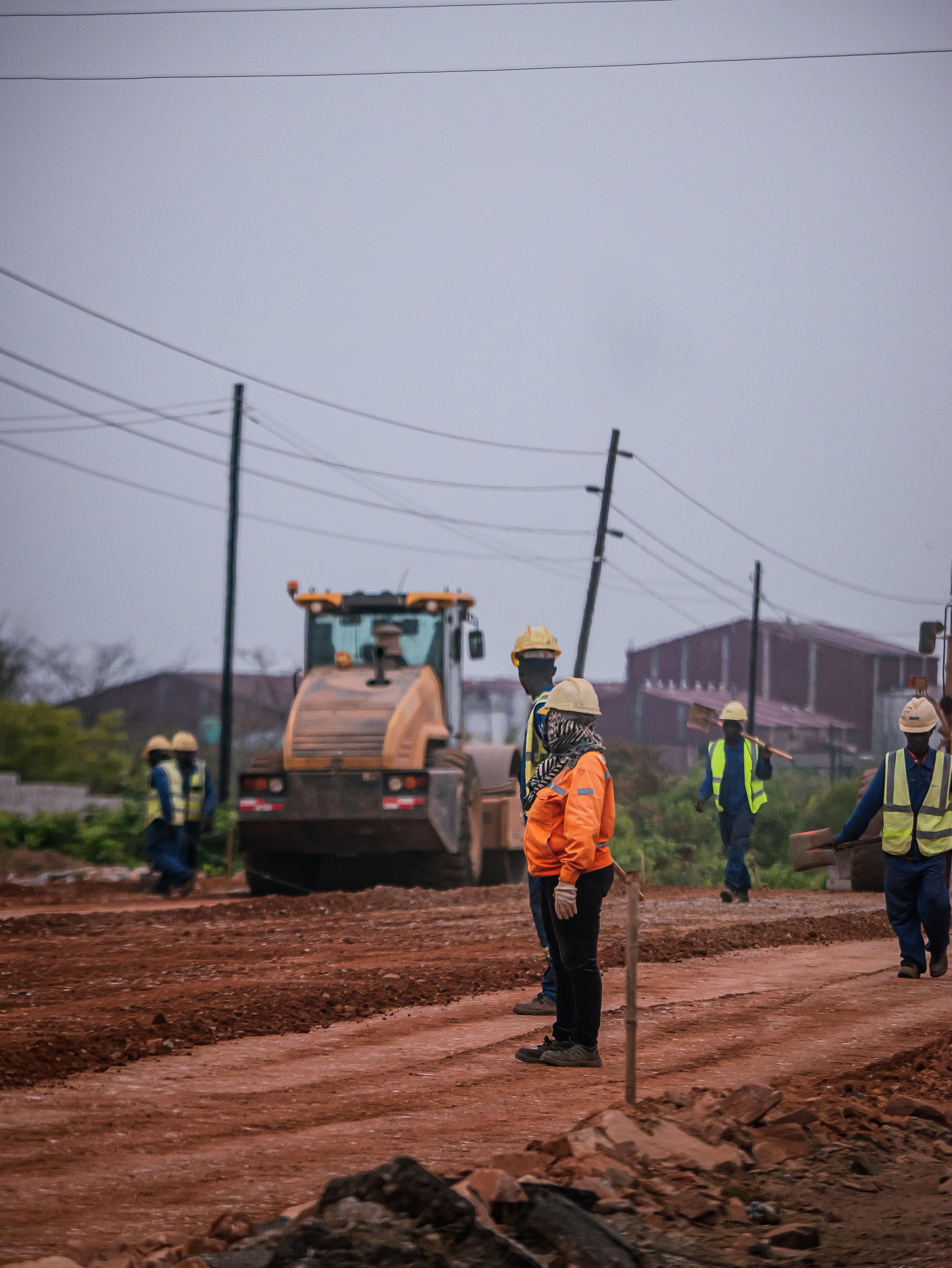
Construction Traffic Control
Traffic control that keeps your build on program.
Overview
TfNSW-compliant traffic control for commercial, civil and residential construction across NSW. Accredited controllers, full Traffic Guidance Schemes, on-site supervision and 24/7 dispatch so your site stays productive and your public risk stays low.
Construction traffic control is where a project either runs smoothly or bleeds hours, and we treat it as core to your build — not an afterthought. Every NSW construction site that affects a road, footpath or shared zone sits under AS 1742.3:2019 Traffic Control for Works on Roads, TfNSW's Traffic Control at Work Sites (TCAWS) manual and, where applicable, a Road Occupancy Licence (ROL). We plan, install and operate site traffic controls that meet all three, designed around your construction sequence rather than a generic template.
The first thing our team does on any new construction engagement is walk the site. That means looking at vehicle movements, crane swings, concrete pours, spoil-truck cycles, deliveries, scaffold erection, temporary structures and pedestrian desire lines. We then sit with your site manager to understand staging — because a Traffic Guidance Scheme that doesn't reflect the real build order is useless by week two. Our designers hold TfNSW accreditation and build Traffic Guidance Schemes — TGSs, the term that replaced the old TCP (Traffic Control Plan) under AGTTM in 2019 — that survive contact with reality.
On the ground we deploy TfNSW-ticketed Traffic Controllers (Blue Card / Yellow Card holders as required for the class of road), with SafeWork NSW White Cards and our own standing Safe Work Method Statements (SWMS). Each crew arrives with the right signage, cones, water-filled barriers, VMS boards, arrow boards and HV-lit plant as the TGS demands. For high-speed or high-volume roads our controllers carry Yellow Card (Traffic Management Implementer / TMI) and a TMD-credentialled designer (Orange Card / Prepare a Work Zone TMP) signs off the TGS where the job calls for it. We also run radio-controlled stop/slow crews for two-way, single-lane closures — the single-most common cause of disputes on tight sites, and something we take real care with.
Commercial builders get a different type of support again. High-rise work in Sydney CBD, Parramatta, North Sydney or Chatswood means City of Sydney, Parramatta or Willoughby Council permits, night-only deliveries, crane oversails, swing-stage rigging closures and constant re-staging. Our crews are used to booking lane closures inside tight night windows — concrete pours at 2am, crane jumps at 5am, tower lift changeovers through the weekend — and getting the site reopened before morning peak. We work closely with your head contractor's traffic management plan holder, or develop one from scratch if you'd rather have everything under one roof.
Civil construction is more route-based — water mains, gas upgrades, pavement rehabilitation, drainage, kerb-and-gutter, cycleway construction. Here we focus on maintaining continuous, safe movement past the works while protecting the crew working in live traffic. That means proper tapers at compliant taper rates, correct buffer and longitudinal zones, pedestrian detours that actually meet disability-access requirements (DDA / AS 1428), and live management of signal-controlled works where we sync with temporary traffic signals or contraflow systems.
For residential-scale construction such as knockdown-rebuilds, multi-unit townhouse sites and small commercial fit-outs, we scale back without cutting corners. A skip-bin delivery across a footpath or a concrete pump setup still needs a TGS, still needs trained controllers, and still triggers council approval — but the cost and paperwork should reflect the scale of the risk, not be priced as though you're closing a motorway.
We also keep your workforce safe from your own plant. Reversing trucks, loading docks, gate movements, and site-exit points are a huge source of incidents, and our controllers regularly cover these with radio comms to the crane and dog-man. SafeWork NSW has been clear on traffic-related fatalities in the construction sector — proper controls aren't optional.
Finally, documentation: we close out every shift with a Daily Diary including TGS confirmation, any incidents or near misses, staff on site, photos of key setups, and sign-on/sign-off records. That's what defends your project in an audit and what builds a clean safety record with your principal contractor. If you work with TfNSW, Sydney Metro, Sydney Water, Transport Canberra or any Tier 1 builder, you'll have the documentation they expect.
We serve every NSW region — Sydney metro, Central Coast, Hunter, Illawarra, Blue Mountains and regional NSW — with a single point of contact, stable crew allocation, and straight pricing. If you're tired of last-minute crew swaps, half-finished TGS drawings or controllers who show up without the right card, talk to us. This is the part of the job we do well.
What you get with Construction
TfNSW-accredited Blue, Yellow and Orange Card controllers
Full Traffic Guidance Schemes (TGS) drawn to AS 1742.3:2019
On-site supervision for complex or multi-crew works
Water-filled barriers, VMS boards, arrow boards, truck-mounted attenuators
Radio-controlled stop/slow crews for single-lane contraflow
Daily diaries, setup photos and incident reporting
Council and TfNSW permit lodgement and ROL applications
Night-shift and weekend pours handled without drama
Who we do this for
We tune scope, crew size and gear to the client — here are the teams we most often deliver this service for.
Tier 1 and Tier 2 commercial builders
Civil contractors on road, rail and utility works
Principal contractors on multi-trade sites
Developers and project managers running knockdown-rebuilds
Subcontractors needing ad-hoc controllers
Government infrastructure delivery partners
When construction is what you actually need
Plain-English triggers — if any of these match your job, this is the service line we'd put you on.
- Any time your build affects a public road, footpath, kerb or shared zone — even briefly.
- Crane lifts, oversails or swing-stage rigging that crosses a property boundary onto a road or footpath.
- Concrete pours and continuous truck cycles on residential or arterial streets.
- Site entries on classified roads where vehicle movements need controllers under TfNSW rules.
- Footpath occupancy for hoardings, scaffolding, gantries or material loading zones.
- Night works inside CBD, Parramatta, North Sydney or Chatswood deliveries windows.
- Multi-trade staging where vehicle movements change weekly and the TGS needs to keep up.
Typical projects
A snapshot of the kind of work this service line delivers across NSW every week.
- High-rise tower deliveries in Sydney CBD and Parramatta
- Pavement rehabilitation on arterial roads
- Water main and drainage works under Sydney Water contracts
- Concrete pours and crane jumps requiring night lane closures
- Civil infrastructure works for councils and TfNSW
- Multi-unit residential and townhouse builds
How construction jobs come unstuck
Honest list — these are the failure modes we see when traffic control is skipped, under-scoped or handed to a generalist.
Generic TGS copied from a template that doesn't reflect the build sequence.
What happens: Council or TfNSW reviewer rejects the plan; the pour or crane jump is delayed and you wear the rebooking cost.
Controllers turn up without the right ticket for the road class.
What happens: Site supervisor sends them home, the head contractor's safety officer flags it, and the head contractor's ticket-list audit finds you next quarter.
Tapers calculated for the wrong posted speed — usually under-length on 70 km/h+ roads.
What happens: First near-miss puts the SafeWork notification on your desk by lunchtime. Insurance treats it as a control failure.
Pedestrian detour drops below AS 1428 (1.2 m clear width, kerb ramps, tactile indicators).
What happens: DDA complaint to council, immediate stop-work on the footpath, retro-fit crew costs and PR damage on a community-sensitive site.
ROL lodged late — assuming TfNSW will turn it around in a week.
What happens: Standard ROL is 10–21 business days. Site shutdown until approval lands. Programme slips and you're explaining it to the principal.
From first call to Construction on site
The shape of an engagement on this service line. Same process whether it's a single shift or a multi-year contract — only the scale changes.
Site walk and staging review
Before we quote, we walk the site with your foreman and site manager. Crane swing, vehicle movements, pour cycles, scaffold erection, oversails, and where the public actually walks. We don't price off a Google Maps screenshot.
TGS design (formerly TCP)
Our Orange Card-holding designers draw a TGS that survives the build sequence — multiple stages where the site changes, with sequencing notes so your foreman knows which plan is active on which day.
Permits and ROL lodgement
We lodge council street-occupancy permits or the TfNSW Road Occupancy Licence, with all supporting docs (SWMS, COIs, plans) bundled. We track approval and surface any reviewer comments before they become delays.
Crew rostered and pre-briefed
Stable crew allocation — same controllers across the project where possible — ticketed for the road class, briefed against your SWMS and the TGS revision before they hit site.
Live shifts and daily diaries
Setup, run and break-down to plan. Daily diary lands in your inbox the next morning: TGS reference, sign-on/sign-off, setup photos, traffic counts where relevant, and any incident or near-miss notes.
Stage transitions and close-out
When the build moves to the next stage, the TGS reissues under revision control, the ROL gets varied, and the crew is briefed on the change. At project close we hand over an audit-grade pack of diaries and TGS history.
What you're actually paying for
No hidden margin — these are the levers that move the price up or down on every quote we write for this service.
Road class and posted speed
Local street at 50 km/h is one band. 80–100 km/h classified road needs Yellow/Orange Card crew, longer tapers, TMA shadow vehicle and sometimes VMS — that lifts the per-shift cost noticeably.
Crew size and shift length
Standard 10-hour day with two controllers is the baseline. Add a controller per pinch point (typical for inner-city pours) and add hours for set-up and pack-down outside the productive window.
Time of day
After 6pm, before 6am, weekends and public holidays carry award-driven loadings. We list them per-shift on the quote so you can compare scheduling options honestly.
Equipment package
Cones and signs are included. VMS boards, water-filled barriers, arrow boards and TMAs are itemised — you only pay for what your TGS actually calls for, not a fixed bundle.
TGS / TMP design and lodgement
Single-stage TGS is a flat fee. Multi-stage projects, TfNSW corridor work and ROL management are scoped per design hour — typically a one-off cost at project mobilisation.
Project duration
Long-running projects (3 months+) get standing-rate agreements with locked crew, predictable invoicing and one mobilisation rather than per-callout fees.
Real shift, anonymised
One job we delivered on this service line. Names and locations are kept generic; the operating detail is exactly as it ran.
Mid-rise tower, Parramatta CBD — 14-month build
Tier 2 builder, 22-storey mixed-use tower on a constrained CBD block with two-frontage road impact and a council-mandated night delivery window between 10pm and 5am. We ran a four-stage TGS through the build: bulk excavation (single-lane closure with TMA), tower-crane erection (full closure for 14 hours over a Saturday), tower up and form-deck pours (rolling night closures across 60 pours), and façade install (kerbside swing-stage protection). Three controllers per shift in core, scaled to five during crane jumps, with our Orange Card designer holding the live TGS revision file. Zero ROL rejections, zero SafeWork notifications, no neighbour complaints to council escalated. The principal contractor moved their other CBD project to us in month nine.
Regulations & accreditation
Every Construction job is delivered to the current NSW standards and codes of practice.
Regulations we work to
- AS 1742.3:2019 Traffic Control for Works on Roads
- TfNSW Traffic Control at Work Sites manual (TCAWS)
- SafeWork NSW WHS (General) Regulation 2017 Part 3.2
- Road Occupancy Licence (ROL) where required
- Local Council street-occupancy and standing-vehicle permits
- AS 1428.1 pedestrian access and mobility
Construction — FAQs
Frequently asked questions
Construction across NSW
Our most-requested NSW locations for this service. Click through for local detail — landmarks, major roads, project history and response times.
Other services we run alongside construction
Most NSW projects need more than one of our service lines at some point. Here are the ones we hand off to most often on this kind of job.
Traffic Management Plans (TMP & TGS)
TMPs and TGS drawings that pass council and TfNSW first time.
See TMP & TGSUtility Works (Ausgrid, Sydney Water, Jemena, Telstra)
Utility-aware traffic control that matches your response window.
See Utility WorksRoad Maintenance & Line Marking
Road maintenance traffic control that moves with the crew.
See MaintenanceEmergency Response & After-Hours
24/7 dispatch when the road goes sideways.
See EmergencyNeed construction on your NSW site?
Send your dates, site address and scope — we'll come back with a crew, a gear list, and a fixed quote.